



If I had a dollar for every time a patient sat in my chair and asked, “Doc, what’s the actual difference between porcelain and composite veneers?”, I could probably retire.
There is a lot of noise online. Some sources say composite is “just as good” as porcelain. Others say porcelain is the “only real option.” The truth? They are just different tools for different jobs.
I’ve been doing cosmetic dentistry for over 10 years, and I’ve seen what these materials look like on day one, and—more importantly—what they look like ten years later.
Here is the no-nonsense breakdown to help you decide which route fits your mouth (and your wallet).
The Basics: What Are We Actually Putting on Your Teeth?
Forget the technical jargon for a second. Here is the easiest way to visualize it:
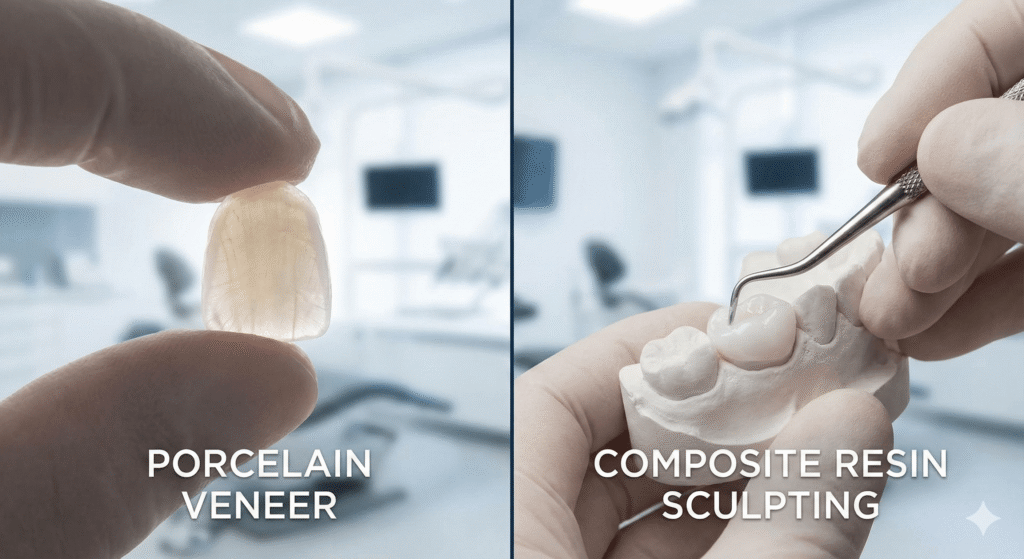
Porcelain Veneers are like fine china. They are made in a lab by a master ceramist who layers glass powder to mimic a real tooth. They are hard, glossy, and don’t stain. We glue them onto the front of your tooth.
Composite Veneers are like high-end sculpting clay. There is no lab involved. I apply a putty-like resin directly to your tooth while you are in the chair, shape it by hand, and harden it with a blue light. It’s basically the same material we use for white fillings, just highly polished.
Porcelain Veneers: The “Permanent” Fix
I usually recommend porcelain when a patient tells me, “I want to do this once, and I want it to look perfect.”
Why I love them:
They mimic nature: Real enamel isn’t opaque; light passes through it. Porcelain does the same thing. It has a “depth” that makes the teeth look alive, not like white chiclets.
The “Teflon” effect: Porcelain is essentially glass. You can drink black coffee, red wine, or eat curry, and the veneer simply won’t stain. I have patients come back for checkups 12 years later, and the veneers are just as bright as the day we cemented them.
Strength: Once bonded, they act like part of the tooth. They are incredibly difficult to break.
The hard truth:
You can’t go back. To make porcelain fit without looking bulky, I almost always have to shave off a thin layer of your natural enamel (about 0.5mm). Once you do this, you are committed to veneers for life.
Composite Veneers: The Artist’s Approach
Composite is a fantastic option, but it serves a different purpose. I often call this “same-day bonding.”
Why I love them:
Minimal drilling: In many cases, I don’t have to touch your natural tooth structure at all. We just roughen the surface and build on top. If you get tired of them in 5 years, we can potentially remove them, and your natural teeth are still underneath.
Fixable: If you crunch down on a fork and chip a porcelain veneer, the whole thing usually has to be replaced. If you chip a composite, you come in, I add a little more material, polish it, and you’re out in 20 minutes.
Cost: Because there is no lab bill, they are significantly cheaper.
The hard truth:
They aren’t forever. Think of composite like a really nice Tupperware container. It’s great at first, but after a few years of tomato sauce (or coffee/tea), it starts to pick up color. They also lose their shine faster than porcelain and need to be polished annually to keep looking fresh.
Quick Comparison
Here is a snapshot of what you are signing up for with each.
| Factor | Porcelain Veneers | Composite Veneers |
| Aesthetics | Unbeatable. Looks exactly like real enamel. | Very good, but can look a bit “flat” or matte over time. |
| Stain Resistance | Excellent. (Impervious to coffee/wine) | Moderate. (Will stain like natural teeth do) |
| Lifespan | 10–15+ years (often longer with care) | 5–7 years |
| Time in Chair | 2-3 visits over a couple of weeks. | Done in one single appointment. |
| Reversibility | No. Enamel is usually removed. | Yes (or at least, much easier to reverse). |
| Price | High (Paying for lab + material). | Moderate (Paying for dentist’s time). |
So, Which One is “Better”?
“Better” depends on your situation.
I’ll steer you toward Porcelain if:
You are looking for a significant change—like fixing severe discoloration (tetracycline stains) or closing big gaps. If you are a smoker or a heavy coffee drinker, porcelain is practically mandatory if you want them to stay white. It’s the “Gold Standard” for a reason.
I’ll steer you toward Composite if:
You are young (under 25) and we want to preserve your enamel. Or, if you just have minor chipping on the edges of your front teeth. It’s also a great “test drive.” I have had patients do composite for 5 years, save up money, and then upgrade to porcelain later.
Common Questions I Get
“Can you tell the difference by looking at them?”
Honestly? If I do my job right, no one should know you have veneers, regardless of the material. But up close, after about 3 years? Yes. Porcelain stays glossy and wet-looking. Composite tends to get a little duller texture unless you are religious about polishing it.
“Does the procedure hurt?”
Composite bonding is usually painless and often done without any numbing at all. Porcelain requires numbing because we are prepping the tooth, but once the numbness wears off, it’s mostly just sensitivity to cold for a few days.
“Why is porcelain so much more expensive?”
You aren’t just paying me. You are paying a master ceramist in a lab to hand-layer ceramic powder under a microscope. It’s art. With composite, I’m the artist in the chair. It takes skill, but it doesn’t incur those massive lab fees.
Common Questions I Get
“Can you tell the difference by looking at them?”
Honestly? If I do my job right, no one should know you have veneers, regardless of the material. But up close, after about 3 years? Yes. Porcelain stays glossy and wet-looking. Composite tends to get a little duller texture unless you are religious about polishing it.
“Does the procedure hurt?”
Composite bonding is usually painless. Porcelain requires numbing because we are prepping the tooth, but once the numbness wears off, it’s mostly just sensitivity to cold for a few days.
“Why is porcelain so much more expensive?”
You aren’t just paying me. You are paying a master ceramist in a lab to hand-layer ceramic powder under a microscope. It’s art. With composite, I’m the artist in the chair. It takes skill, but it doesn’t incur those massive lab fees.
The Verdict: Why Porcelain Is The Superior Choice
While both options improve a smile, let’s be honest about the long game.
Composite veneers are a great “band-aid” or a stepping stone. They are fantastic for fixing a minor chip or for young patients waiting to mature. But if you are looking for a true transformation—the kind of smile that stops people in their tracks and stays white while you enjoy your morning coffee—Porcelain is the undisputed winner.
Think about it this way: Composite is like renting an apartment. It solves the immediate need, but you’ll be moving again in a few years. Porcelain is like buying your dream home. It’s an investment in quality, stability, and lasting beauty.
In my practice, the patients who are happiest 10 years down the road are almost always the ones who chose porcelain. They haven’t had to worry about staining, chipping, or dullness. They just wake up every day with a perfect smile.

Written and clinically reviewed by
Cosmetic Dentist · 10+ years experience · Gazi University · Best Dental Istanbul
Last updated